

I was once on a public discussion panel about astrology, by mistake. It was years ago, I was invited to be on panel at an event, I think there may have been a fee. So I sallied up, assuming that it’d be all about etymology or poetry or something. Instead, it was astrology.
I’d recently published a book called The Horologicon, and somehow wires had got crossed, and somebody had looked at the title and made a guess that I was an avid star-gazer and seer.
I ended up as a sort of mediator between the two sides, who were arguing crossly about the whole thing. And the odd thing was that, though I didn’t say so aloud, I found myself disagreeing with both sides.
I shall attempt to explain why.
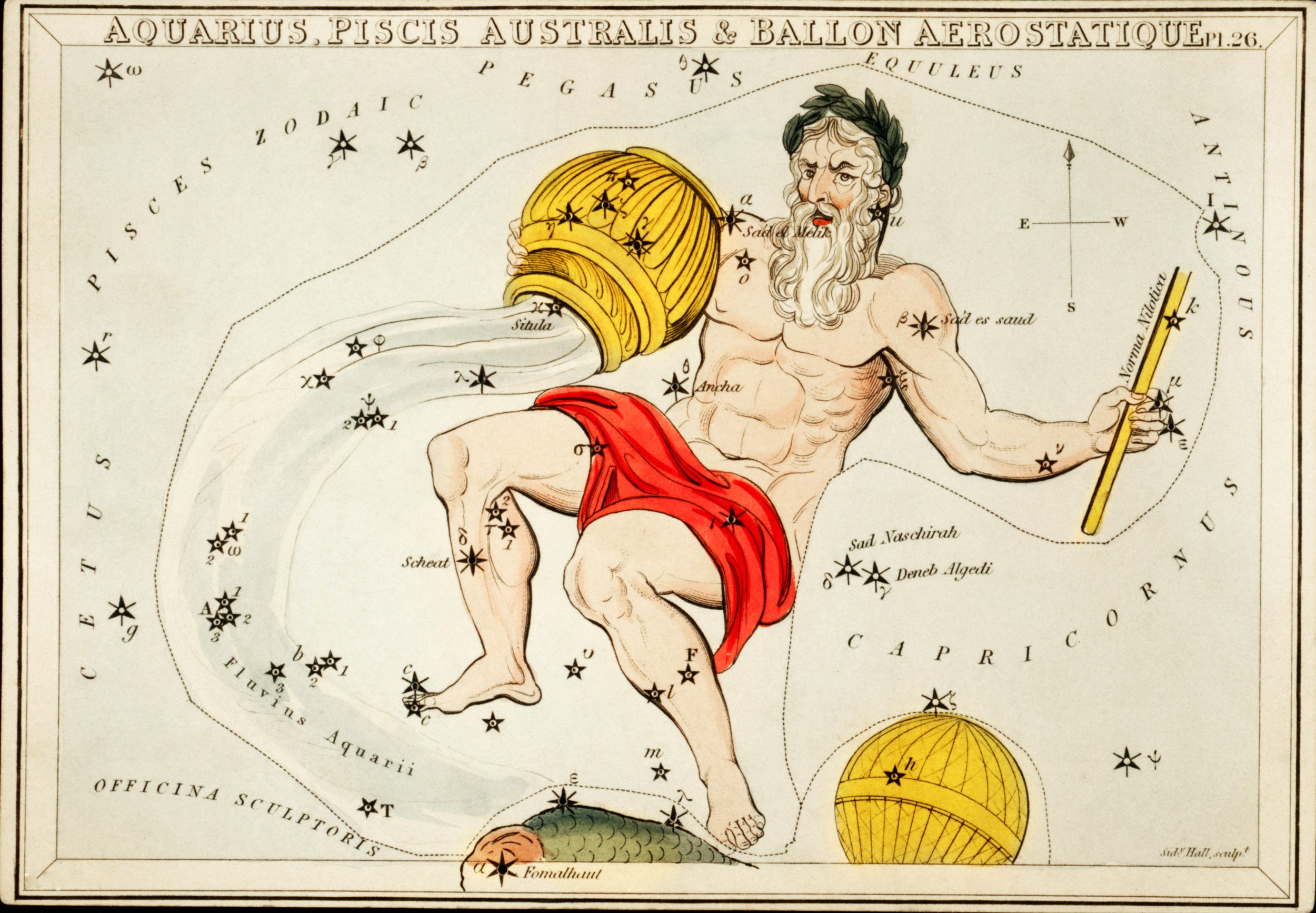
On the surface of it, the principle of a horoscope is that your life can be affected, and your future decided, by big balls of hydrogen and helium trillions of miles away.
This is, to put it gently, not that plausible.
And yet, horoscopes survive. The Babylonians loved them, and the Romans, and the Medievals, and just about everybody. The proud march of science doesn’t seem to affect them one little bit. Indeed, they’re popular in Britain, which is a cloudy island, from which the stars are rarely, if ever, sighted.
They’re also believed by people who don’t have the first smidgen of knowledge, or interest in, the stars. People who couldn’t identify Aries on a clear night with a good telescope, organise their life around the fact that they were born in that astronomical house. Which seems rather illogical.
But, on the other hand, the horoscope-knockers, the sceptical, unbelieving hard-facts and brass-tacks brigade tend to be rather illogical about them too. The general line of attack is double-pronged.
Horoscopes are based on distant stars and cannot be correct.
Horoscopes are deliberately vague, and the vagueness means that they’ll always be correct.
These two propositions are contradictory, and illogical.
But I think that if you take a more ridiculous position, then things actually start to make sense, from both sides.
Supposing I decided to organise my life alphabetically.
On Monday I would deal with money, because they both begin with M.
On Tuesday I would play tennis.
On Wednesday I would do the washing up.
And so on and so forth.
And supposing that I said that I knew that I wasn’t actually better at socialising on Sunday, but that that was just how I like to organise things.
Could you tell me that it was actually incorrect?
An action can’t be incorrect, only the theory behind it.
If I did organise my week like that, I imagine it would be a jolly good thing. My weeks, as stands, have no organising principle at all. Any method, however absurd, that made me actually get around to Doing Stuff would be good.
However, the days of the week thing would get a bit samey. My tennis would improve, but what about everything else? What about all the things I didn’t even consider, because they never cross my mind?
What I really is need is a generator of utterly random advice. Something that would give me the advice I would never think of myself. Random is difficult, so you’d have to have a mechanism that’s entirely arbitrary, let’s say the position of the planets in relation to the fixed stars. And then, to avoid useless advice like “throw carrots at a motorbike”, you’d need to have somebody interpret those positions into advice that might work for me.
And thus, I have created the horoscope, from scratch.
All of the forms of divining I can think of work by the introduction of a random element. There’s the tea-leaves in the bottom of your cup, the page you open for the Sortes Virgilianae, the I-Ching. My favourite is a method I once read about but can’t remember the name of. It was Persian. The idea was that when faced with a great and intractable question, you should hide behind a hedge and listen to the conversations of passers-by. The first thing you hear will, somehow, tell you what you need to do.
Of course, you need to interpret what you hear. Suppose you’re wondering whether to quit your job and you hear somebody telling their dog that it’s time to go walkies, then you say to yourself “Aha! I am the dog that needs to be released from my leash! I shall quit!”
You need something to get you out of the rut of your old way of thinking.
I remember talking to a chap who did a fair amount of video editing, which included adding the music. He told me how he sometimes liked to add random music tracks, or ones from previous videos. The visual would then become completely different. A city street could go from being dank and drear to being cool and interesting. If the drum-beat dropped at exactly the moment that a leaf fell from a tree, then the leaf became, by implication, the most important thing in the video.
The purpose of horoscopes, and of divination in general, is simply to make a fellow look at his life in a different way. When your mind is a seething mass of deadlines, breadlines and overdrafts, the bland, vacuous recommendation that:
Neptune is the ascendant, so today is a good day to tell someone close to you how you really feel about them.
Could actually be the commandment that you required. It might make you run through all the people that are close to you and wonder which it is, and what it is that you should tell them. And that is a thought that, otherwise, might not have occurred to you all year.
Thus the contradictions at the beginning of this little essay are all cleared up. The stars are irrelevant; or, if they are relevant, it is only because they are random.
The horoscope is beneficial, how could it be otherwise? The world revolves upon it’s axis in the middle of an absurdly large universe, and the order that we bring to it is necessarily invented.
It is useful to believe, it is simply unfortunate, for me, that I don’t.
Which is why I’m off to hide behind a hedge and listen to the passers-by. I find it’s the best way of planning my weekend, although it would be rather embarrassing if I got caught doing it, again.
Most need some kind of structure for life. Something bigger than the self. With religion gone quiet, horoscopes, misunderstood and unreplicable psychology, and politics have filled that need for now. But only until the alphabetized life reaches mass adoption. Maybe I'll do mine in ancient greek characters just to be odd?
I'm still stuck on the "carrots at a motorbike" idea though...