
Cromulent and Esquivalient
How fictional words become real

Somebody asked me recently whether cromulent was a real word. The answer is that it is now. Cromulent is a perfectly cromulent word.
It goes back to 1996 and the seventh series of The Simpsons. The Simpsons is set in the town of Springfield, which was founded by Jebediah Springfield in 1796. His statue stands in front of the Town Hall, and on it are carved the words A NOBLE SPIRIT EMBIGGENS THE SMALLEST MAN.
Whilst the children are learning about this, two teachers discuss the phrase. Edna Krabappel mentions that she had never heard the word embiggen until she moved to Springfield. Miss Hoover replies that embiggens is “a perfectly cromulent word.”
At the time, cromulent was not a word. That was the joke. It was invented by the writer David X. Cohen as something utterly meaningless. If you’re a Latin scholar you might know that -ulent means ‘full of’ or ‘abounding in’, as in the adjectives fraudulent, opulent, virulent and all sorts of other words that are used to describe my dinner parties.
But crom is not a Latin stem. My dictionary goes straight from crocus, which meant yellow, to crotalistria, which meant castanet-dancer.
But is cromulent in the dictionary? It is now. The OED defines it as:
Acceptable, adequate, satifactory.
And it lists four examples of usage from the last thirty years. Webster’s Dictionary also now contains the word. I just did a quick search of academic papers on Jstor and found six occurrences of the word cromulent. There’s a paper on evolutionary biology that says:
On the other hand, the degree of kin competition achieves a clean dichotomy that is general under all model assumptions. This makes “kin competition” the most cromulent concept in terms of accurately depicting evolutionary dynamics.
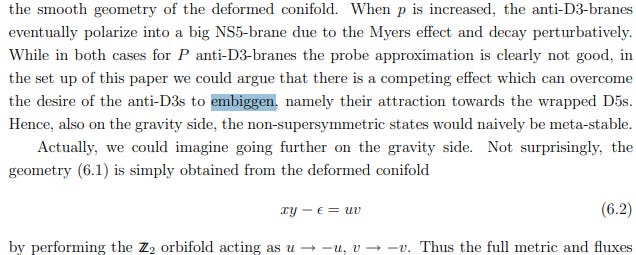
Embiggens is similar. Though the OED lists a solitary use in 1884, the same Simpsons scene introduced it afresh to the English language, and it has become a term in String Theory. You’ll find it a scientific paper on “Gauge/gravity duality and meta-stable dynamical supersymmetry breaking” (2007)
Words are human creations, and they are real for as long as we use them. My favourite is the word esquivalience. It was invented as a trap-word for the New Oxford American Dictionary.
An honest lexicographer does all the hard work of collecting words and trying to define them. A dishonest one just copies from other dictionaries. As a result, honest lexicographers need to put one fake word into their dictionary, and with the one fake they will catch a plagiarist. That’s the trap.
That’s what the word esquivalience was doing in the New Oxford American Dictionary, where it was defined as:
the willful avoidance of one’s official responsibilities… late 19th cent.; perhaps from the French esquiver, ‘dodge, slink away.’
How the word then ended up on dictionary.com was a mystery.
A couple of years ago, I wrote a children’s novel called A Riddle for a King. The story is about a magical kingdom whose king has run away in a flying castle. At the end, the king finally returns and all is sorted out for a [SPOILER ALERT] happy ending. And the king repents of his wandering. He says:
There I was twiddling my thumbs in the Flying Castle, when I should have been doing my job. From this day forth I shall do what I’m meant to do. I shall perform my kingly tasks. I shall stop shirking my duties. I shall stop my… esquivalience!
So, you see, I use esquivalience. And if enough people use it, it shall be as real as embiggens. Esquivalience will become a perfectly cromulent word.
And now I am off for a good lunch, and an esquivalient afternoon.
You have my most enthusiastic contrafibularities, sir.
Have a perfectly cromulent afternoon, irregardless of what happens.